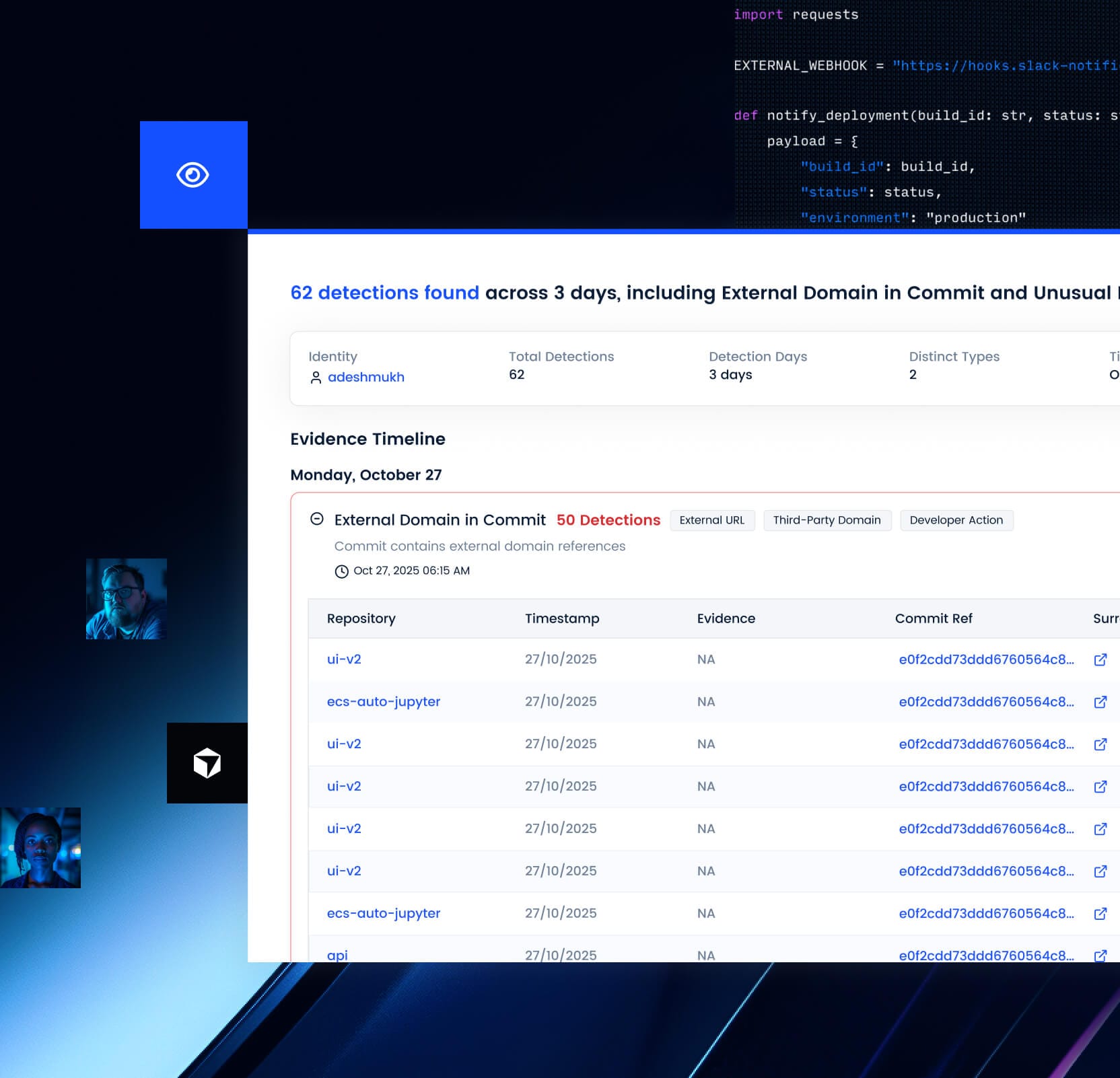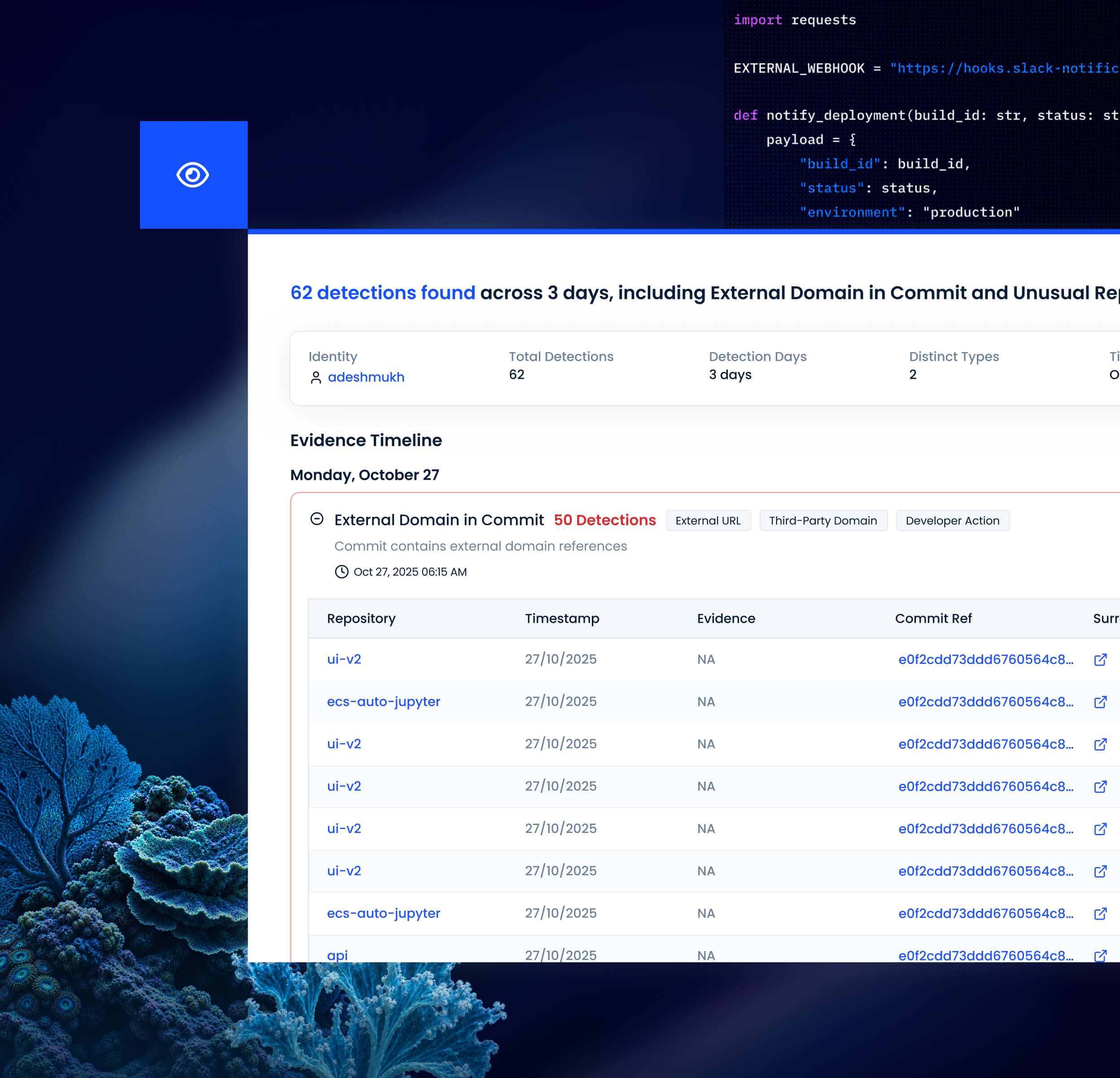
BlueFlag governs your software development ecosystem: human developers, non-human identities, AI coding agents, and the tools and pipelines they work through. We learn what normal behavior looks like, catch the moment it changes, and fix what we find before it reaches the surface.
They start with the identities behind it: AI agents, human and non-human developers, and the tools, repositories, and CI/CD pipelines they interact with across your development environment.
Software runs your business. The identities and pipelines building it hold the leverage. Attackers go where the leverage is — not your code.

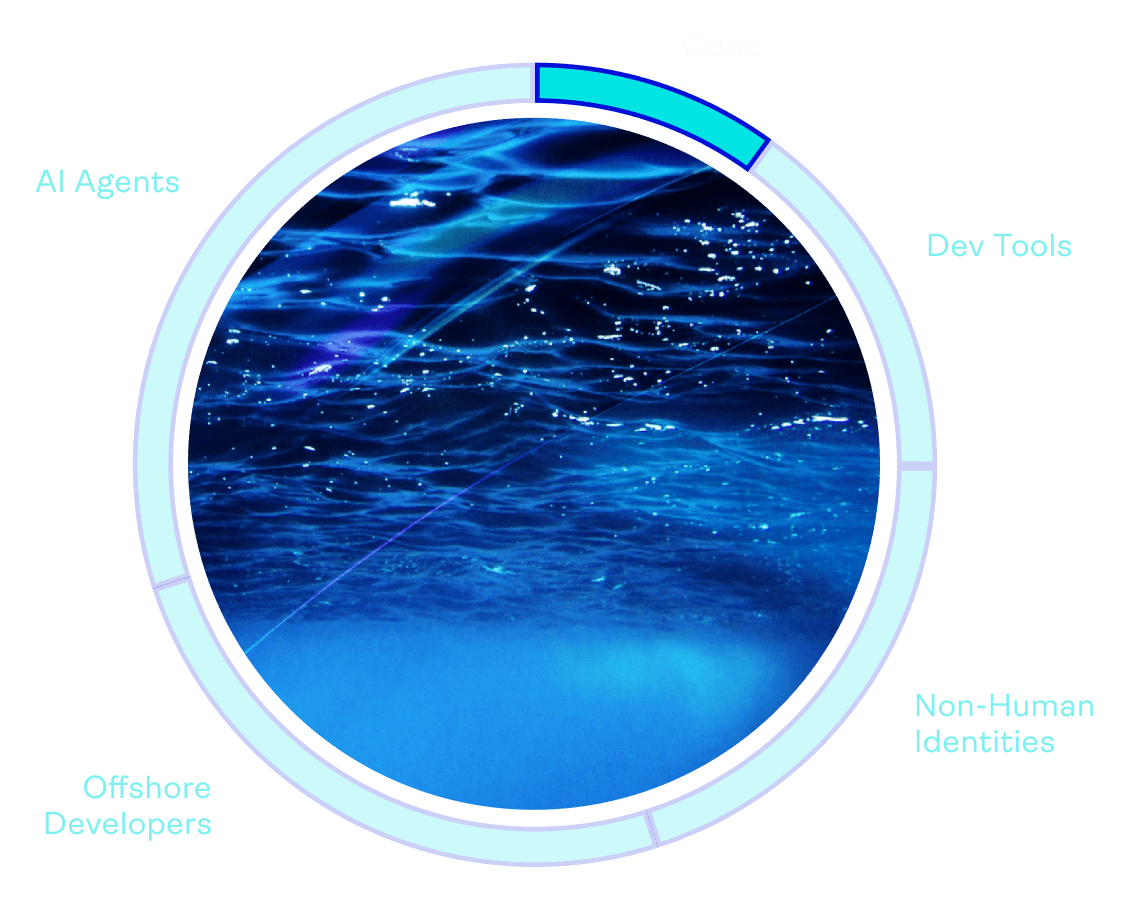

If it writes, tests, deploys, or accesses your code —
we see it, we govern it, and we stop it.

Copilot, Cursor, testing agents,
deployment automation.

Internal developers, external
contractors, offshore developers.

Service accounts, bots, tokens,
API keys, automation.

SCM, CI/CD, artifact repositories and
build systems.
AI agents are no longer just tools your developers use. They act on your code with judgement of their own, and almost no one governs them. They do not ask for access. They inherit it.
BlueFlag treats every AI agent as a first-class identity, so when something goes wrong, you know exactly what happened and why it matters.

Every AI agent in your SDLC, approved and unapproved, is discovered and tied to the developer whose credentials it inherited. No agent without an owner.

Every repository and pipeline each agent can touch, exactly what it can do there, and where it holds more permission than its work requires. No permission without a purpose.

BlueFlag learns how each agent normally behaves and catches the moment it changes, so you know what happened and fix it before it becomes a breach. No change without an explanation.
Breaches don't happen in one step.
They follow an attack path.
BlueFlag correlates signals across identities, tools, and code in your SDLC, surfacing the threats no other tool can find.
Uncovered AI Agent

Autonomous
Code Changes

Approval Workflow Bypassed

Deployed to
Production

Unauthorized Autonomous Deployment
Code & IP Theft

Out-of-Scope
Cloning

Unusual
Repo Cloning

Imminent
Deactivation
Active
IP Theft
Compromised Credentials

Multi-Location
Activity

Same Pull
Request

Jira Ticket
Updates
Unauthorized Access
Malicious Insider Attack

Vulnerable
Dependency

Branch Protection Bypassed

Merged to
Production
Active Insider Attack











"You cannot scan your way out of a compromised identity or patch your way out of an insider threat. BlueFlag gave us visibility into the risks that were hiding in plain sight across our development environment — and the tools to actually act on them."

"We have hundreds of developers, contractors, and service accounts touching our systems every day. BlueFlag was the first platform that gave us a unified view of who is doing what across our entire SDLC — and flagged risks we didn't know to look for."

"Developers are the biggest risk because of advancements in AI. A Risk and Governance Platform for human and superhuman identities is a must-have in the new world of development. BlueFlag made that possible — and it deployed in days, not months."

"The correlation engine is what sets BlueFlag apart. Individual signals that looked like noise turned out to be connected threats. It surfaces the attack paths your team didn't know to look for — and gives you the context to respond."
Rarely through code vulnerabilities. Most software supply chain attacks start with an identity: a stolen developer credential, an overprivileged service account, a forgotten token, or a poisoned CI workflow. The 2026 TeamPCP campaign, Shai-Hulud, and XZ Utils all began with a compromised or abused identity, not a flaw a scanner would catch. The attack surface is not the code; it is who and what controls it.
Mostly no. ASPM consolidates findings from code and application scanners, so it inherits their blind spot. It can tell you a vulnerability exists, but not which identity introduced it, what else that identity can reach, or that an AI agent just merged a pull request no human reviewed. Identity, behavior, and AI agent governance sit outside what ASPM was built to see.
Scanners analyze what gets written. They cannot see who or what wrote it, what else that identity can reach, or whether its behavior just changed. A contractor account cloning repositories at 3am, an admin bypassing branch protection, or an AI agent merging its own pull request all pass a clean code scan, because nothing is wrong with the code.
Usually not. Most developer tools (GitHub, GitLab, Jenkins, artifact registries) do not hang off the corporate identity provider, and the same person is a different username in each one. When HR offboards someone, the corporate credential dies but the developer tool accounts often live on, still holding access and still attached to paid licenses. That gap between corporate IAM and the development environment is where ghost accounts accumulate.
Asking them undercounts, and network monitoring misses tools on personal accounts. The reliable signal is in the development environment itself: which repositories call LLM APIs, which agentic frameworks and packages are embedded in the code, which agents open and approve pull requests, and which commits are AI-authored.
The TeamPCP attacks on Checkmarx and Trivy worked by stealing CI credentials and reusing them to poison trusted workflows, so the defense is identity-side, not scanner-side: know every identity and token with pipeline access, cut permissions that are held but unused, watch for workflow changes and merges that bypass review, and treat every credential a pipeline can read as a target. A poisoned workflow passes a clean code scan; the tell is the identity behaving abnormally.
BlueFlag Security is a Developer Risk and Governance Platform, the system of record for all developer risk: every identity, every tool, and every pipeline in the development ecosystem. It gives security and engineering teams full visibility and governance over who and what ships their code, from first commit to production. BlueFlag connects read-only in under 5 minutes, never touches or copies code, and delivers a full findings report within 48 hours.
Code scanners analyze what gets written; BlueFlag governs who and what writes it. BlueFlag inventories every identity in the SDLC, maps the permissions each holds against what it actually uses, baselines normal behavior, and catches deviations, including for AI agents, which it treats as first-class identities. Scanning finds the vulnerability; BlueFlag finds the identity behind the risk. Most teams run both.
BlueFlag discovers every AI agent and assistant in use, approved and unapproved, attributed to the developers and teams using them, plus the LLMs and agentic frameworks embedded in the codebase down to the specific packages. Each agent is governed as a first-class identity: what it can access, what its normal activity looks like, and a full audit trail of what it did and shipped.
No. BlueFlag connects through a read-only API in under 5 minutes, no agent installed, no changes to developer workflows. It never touches, changes, or copies code; it reads only the data needed for findings, such as identities, permissions, activity, and configurations. Most organizations see a full findings report within 48 hours.
Analysis of recent breaches and identity-based attacks
BlueFlag Security is a Developer Risk and Governance Platform, the system of record for all developer risk: every identity, every tool, and every pipeline in the development ecosystem." Global fix, every page. It gives security and engineering teams full visibility and governance over every identity operating in the development environment: human developers, non-human identities, and AI agents. BlueFlag connects read-only in under 5 minutes, never touches or copies code, and delivers a full findings report within 48 hours.