

What PingCAP has confirmed
PingCAP disclosed on October 19, 2026, that an unauthorized party used stolen service-account credentials between September 9 and October 7 to access certain internal systems, copy data, and obtain source code. PingCAP says it detected the incident on October 7 and began disabling affected credentials that day. By October 14, it had invalidated identified compromised credentials and blocked identified unauthorized access paths. [1]
Its investigation confirmed that exported records included TiDB Cloud usernames and email addresses, organization and project associations, SQL editor text and errors, business and billing information, and encrypted API-key values. Importantly, these categories do not apply uniformly to every customer. PingCAP reports no evidence that data stored in TiDB was impacted; customer-specific scope and potential earlier exploitation remain under investigation. [1]
The company also reports removing excessive cross-project permissions by October 10, remediating four separately identified vulnerabilities by October 14, and expanding audit visibility. [1] The bigger question is what happens when an attacker uses stolen credentials that the platform recognizes as valid.
PingCAP reported unauthorized access spanning approximately 28 days, from September 9 through October 7, 2026. The duration underscores a fundamental challenge in identity security: valid credentials can enable unauthorized activity to persist when organizations lack sufficient context to distinguish legitimate operations from credential misuse.
A boundary failure that spans the SDLC and the cloud
The modern engineering environment is a chain of connected tools: code repositories, CI/CD pipelines, infrastructure-as-code, cloud projects, secret stores, ticketing systems, to name a few. Non-human identities such as service accounts hold that chain together, moving work from one tool to the next. A service account created for one job can hold permissions across many tools and cloud projects. Steal its credential, and the resulting misuse looks like automation, unless you have the context to tell the two apart.
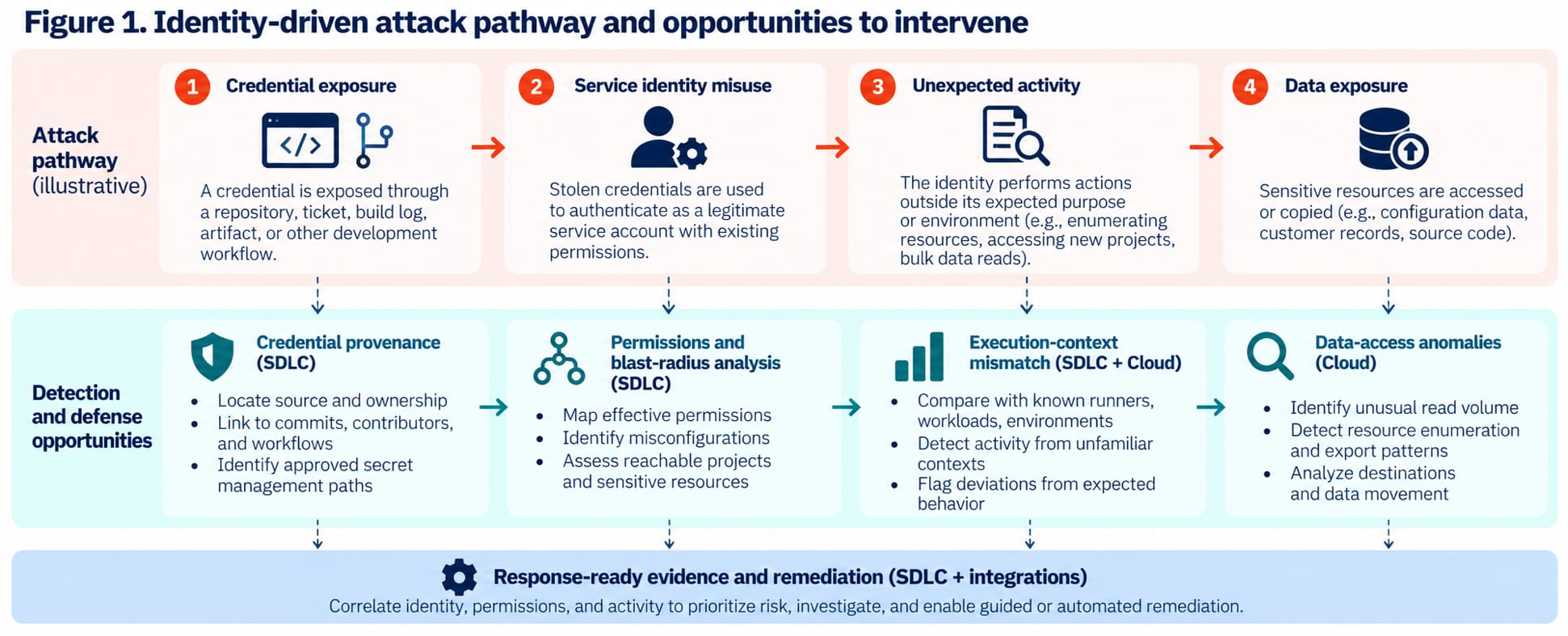
PingCAP has not publicly established how the service-account credentials were obtained. Regardless of their origin, the incident illustrates how compromised non-human identities can bridge development and cloud environments, turning legitimate access privileges into opportunities for misuse. Figure 1 shows how an identity-driven attack can progress from credential exposure to misuse of legitimate permissions and unauthorized data access. Connecting development provenance, identity context, behavioral signals, and cloud telemetry creates opportunities for earlier detection, risk reduction, and coordinated response.
The overlooked dimension: permissions versus purpose
IAM can tell a team that an identity has access to a resource. Cloud logs can show that it called an API. Secret scanners can flag a string that looks like a credential. Each provides an important piece of the picture, but the deeper question is whether the identity’s observed behavior is consistent with its intended purpose, established activity patterns, and authorized workflows.
Consider a hypothetical deployment service account. Its normal pattern is reading configuration and writing deployment artifacts from an approved runner. Later, the same identity begins enumerating unrelated storage buckets and issuing sustained bulk reads. Alone, each request may be permitted. Viewed together, these actions represent a deviation from the identity’s expected behavior and may indicate credential misuse.
This is a correlation problem, not merely an alert-volume problem. Analysts need to know who owns the identity, where it runs from, what it is allowed to do, how sensitive the resources it accesses are, and what it actually did. The more complete the evidence chain, the easier it is to prioritize the suspicious sequence over legitimate backups, migrations, or maintenance.
Connect the evidence, don’t add another alert queue
An actionable graph joins developers to repositories and commits; repositories to build and deployment workflows; workflows to service accounts; service accounts to their effective permissions; and cloud audit events to the resources accessed. Time, source context, and evidence confidence matter as much as the edges in the graph themselves.
Where BlueFlag fits
BlueFlag’s activity intelligence platform addresses a critical visibility and security gap in the modern, agentic SDLC. It connects human developers, non-human identities, and AI coding agents to the repositories, pipelines, build systems, and other development resources they interact with, thus providing a unified view of identities, permissions, and actual activity. By establishing behavioral baselines and correlating anomalous activity with excessive permissions, misconfigurations, and risky workflows, BlueFlag helps organizations uncover potential attack paths, prioritize risks, and take guided or automated remediation actions before vulnerabilities or compromised identities can be exploited.
BlueFlag also strengthens the broader security ecosystem by enriching findings with identity attribution, behavioral context, and end-to-end development activity provenance. When combined with cloud audit telemetry, identity security, and SIEM/SOAR platforms, this intelligence helps security teams connect risks originating in the SDLC to downstream activity, accelerate investigations, and coordinate containment. The result is a shift from fragmented, reactive security toward proactive, identity- and activity-aware protection, where organizations understand not just what an identity is permitted to do, but whether its behavior is appropriate.
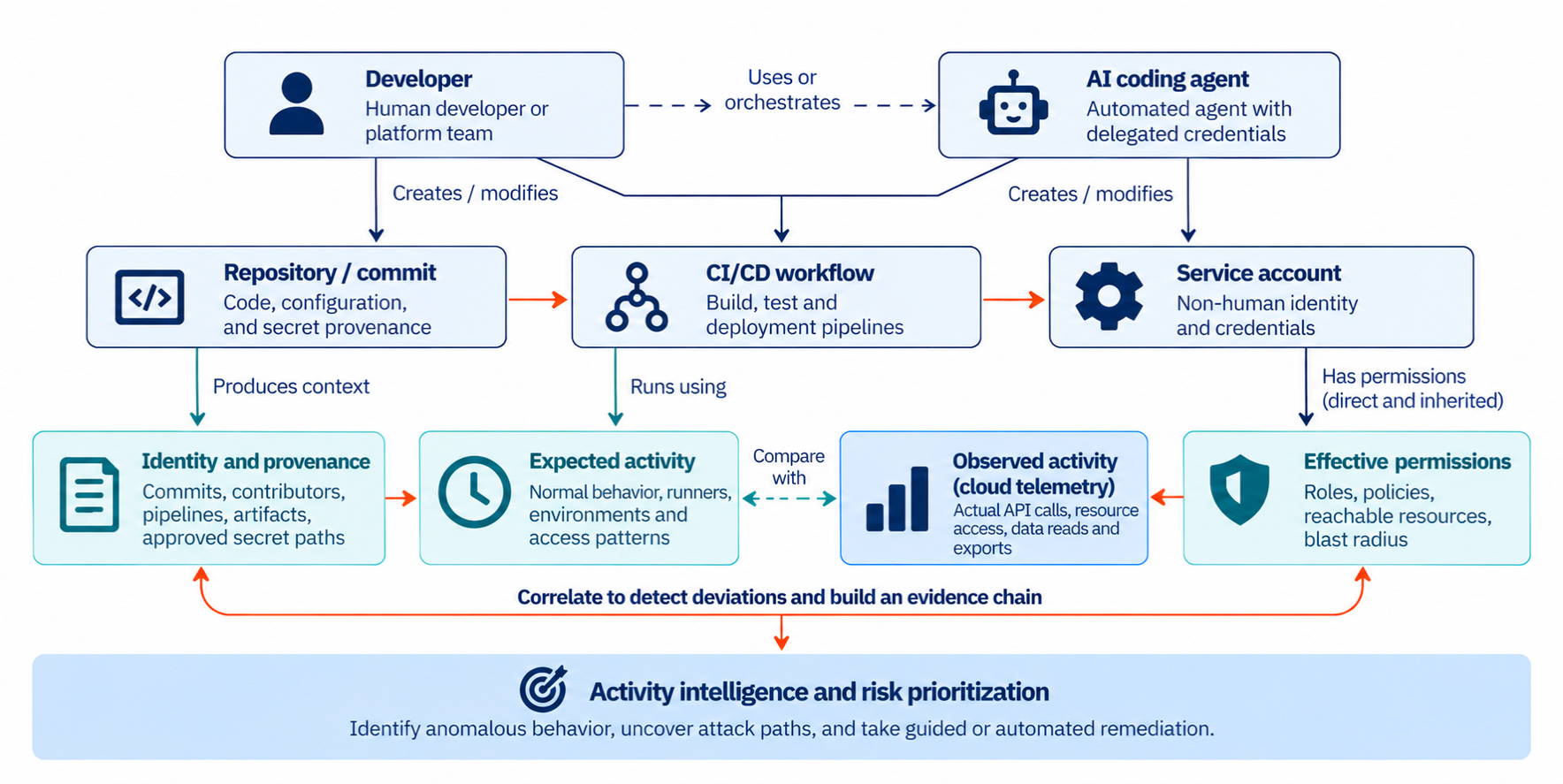
The value of this connected intelligence is its ability to answer three critical questions: (1) Where might a credential have been exposed? (2) What could the associated identity access? (3) What did that identity actually do? By correlating development provenance, permissions, and observed behavior with cloud telemetry where available, organizations can move beyond isolated findings to proactively reduce risk, detect misuse earlier, and accelerate remediation. This creates five practical opportunities to intervene across the attack lifecycle.
Five opportunities to prevent, detect, and respond to identity-driven attacks
1. Credential provenance (SDLC)
Connect secret findings to repositories, commits, contributors, build artifacts, and approved secret-management paths. This can shorten the triage of an exposure.
2. Effective-permission and blast-radius analysis (SDLC)
Associate a service account with granted roles, inherited permissions, reachable projects, and sensitive resources. PingCAP’s reported removal of excessive cross-project permissions illustrates why scope matters. [1]
3. Execution-context mismatch (SDLC + Cloud)
Compare identity activity with expected development workflows, approved runners, execution environments, and operational patterns. When integrated cloud telemetry is available, extend this comparison to cloud API activity to identify deviations that warrant investigation.
4. Data-access anomalies (Cloud)
Correlate changes in read volume, resource enumeration, export patterns, and destination context. Repeated or high-volume access is a useful directional concern.
5. Response-ready evidence and remediation (SDLC + Integrations)
Correlate identity ownership, permissions, development activity, and security findings into actionable evidence. Prioritize risky relationships and support guided or automated remediation within the SDLC, while enriching integrated security and incident-response workflows for broader containment.
The agentic-development explosion
AI coding agents and automated tool chains increase the number of actions taken through delegated credentials. The relevant evidence chain expands from “developer → repository → pipeline” to “human → agent → tool invocation → non-human identity → cloud resource → action.” Distinguishing legitimate delegation from credential misuse requires explicit attribution and sufficient logging across those boundaries.
Nothing in PingCAP’s disclosure indicates involvement of an AI coding agent. Nevertheless, the incident highlights a challenge that agentic development makes increasingly urgent. AI agents can write, test, review, and deploy code through delegated identities, executing complex workflows at machine speed. As their autonomy expands, organizations must understand who authorized their actions, what permissions they hold, and whether their behavior aligns with the intended task. Connecting human-to-agent attribution, non-human identities, permissions, and actual development activity is essential to identifying excessive delegation, anomalous behavior, and potential attack paths before they escalate into broader security incidents.
A practical agenda for security leaders
Security leaders should use this incident to reassess how non-human identities are governed across development and cloud environments. Priorities include identifying long-lived credentials and excessive permissions, detecting secrets exposed through development workflows, establishing behavioral baselines for human and non-human identities, and correlating development activity with cloud audit evidence. Equally important is ensuring that high-risk findings lead to timely credential rotation, privilege reduction, and coordinated remediation. PingCAP separately recommends that affected TiDB Cloud customers review and rotate relevant credentials and remain alert to targeted phishing. [2]
The goal is to close the gap between what an identity is permitted to do and what it should be doing, ideally before compromised credentials, excessive privileges, or anomalous activity escalate into a broader security incident. In the agentic SDLC, that requires continuous visibility into identities, permissions, and behavior, supported by connected evidence and timely remediation.
Source notes and references
Editorial method: Incident-specific statements rely on public PingCAP disclosures. Secondary reporting was studied for corroboration and context, not as independent forensic verification. Unverified attacker-reported figures and named downstream victims have been excluded. All diagrams and detection examples are conceptual.
[1] PingCAP, “Security Update – October 2026 Security Incident Report,” October 19, 2026. https://www.pingcap.com/trust-hub/security/security-update-october-2026/
[2] PingCAP, “Security Update – Customer Actions,” October 20, 2026. https://www.pingcap.com/trust-hub/security/customer-actions-october-2026/